OWASP Top 10 2026: What Changed and What to Fix First
 WeSecureXNovember 18, 2026
Every few years, the Open Worldwide Application Security Project publishes an updated list of the ten most critical web application security risks. That list, the OWASP Top 10, shapes how security teams prioritize work, how scanners categorize findings, and how auditors evaluate applications.
The 2026 edition brings meaningful changes. Some risks moved up, some moved down, and some were reframed to reflect how modern applications actually fail. If you are still working from an older version, your priorities may be out of date.
This guide explains what changed, what each risk means in plain language, how scanners detect them, and what to fix first. If you are new to scanning, start with our vulnerability scanning guide.
Quick Answer
The OWASP Top 10 2026 keeps broken access control at the top, elevates software supply chain failures, sharpens the focus on insecure design, and expands coverage of API specific risks. If you only fix five things this year, fix broken access control, injection, insecure design, supply chain weaknesses, and security misconfiguration.
What Is the OWASP Top 10?
The OWASP Top 10 is a regularly updated list of the most serious risks facing web applications. It is not a standard or a compliance requirement on its own, but it is widely referenced by auditors, security tools, and regulators.
The list is built from real world data. OWASP collects vulnerability statistics from hundreds of organizations, analyzes breach reports, and surveys security practitioners. The result is a ranked list that reflects where actual risk lives.
Because it is updated only every few years, each edition signals a shift in where the industry sees the biggest problems.
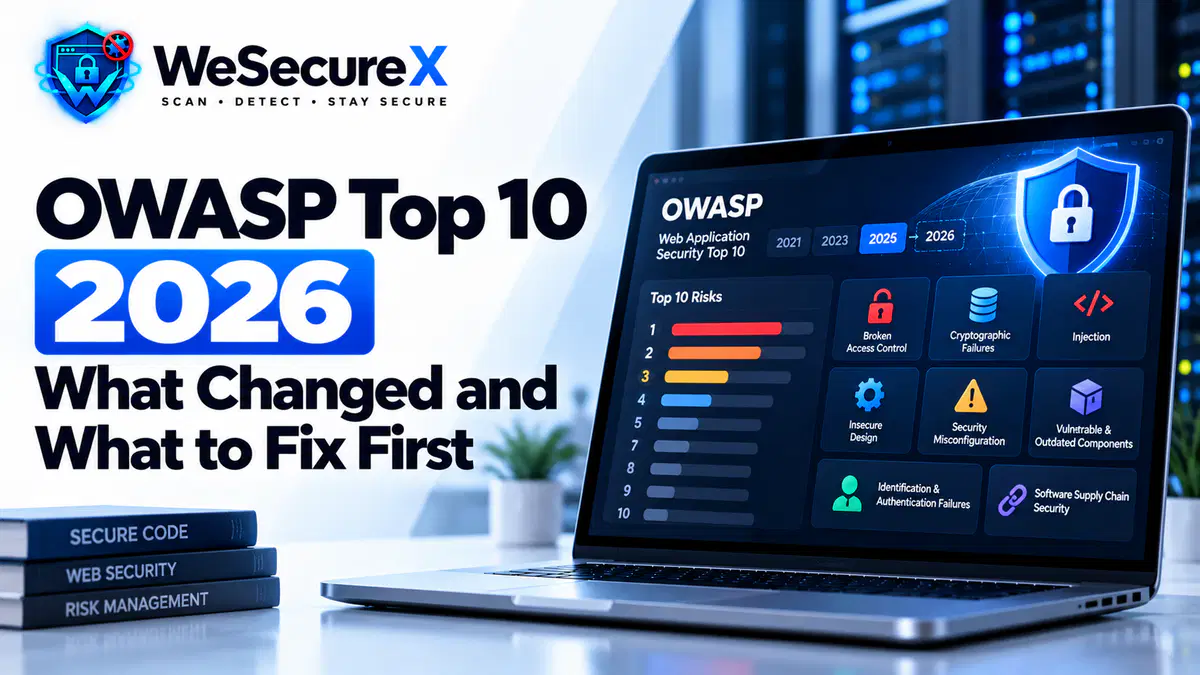
The OWASP Top 10 2026 List
Here is the current list, in order of risk.
Broken Access Control
Cryptographic Failures
Injection
Insecure Design
Security Misconfiguration
Vulnerable and Outdated Components
Identification and Authentication Failures
Software and Data Integrity Failures
Security Logging and Monitoring Failures
Server Side Request Forgery
Each item deserves attention, but the order matters. The risks at the top are the ones attackers exploit most often in real incidents.
What Changed in 2026
The 2026 edition is not a complete rewrite. It is a refinement based on new data and new attack patterns. Here are the most important shifts.
1. Broken Access Control Remains Number One
Broken access control has held the top spot for multiple editions, and it stays there in 2026. This is not surprising. Authorization flaws are the most common cause of serious data exposure in modern applications. Our guide on API security best practices covers how often these appear in API environments.
The 2026 update sharpens the definition to include issues like insecure direct object references, missing function level checks, and privilege escalation through misconfigured roles.
2. Software Supply Chain Risks Are Elevated
Supply chain attacks have grown sharply. Attacks like SolarWinds and the Log4j incident showed how a single compromised dependency can affect thousands of organizations. The 2026 list gives more weight to software and data integrity failures, covering:
Unverified dependencies
Compromised build pipelines
Unsigned artifacts
Insecure CI/CD configurations
Tampered update mechanisms
If you have not reviewed your dependency management recently, this is the year to do it.
3. Insecure Design Gets More Emphasis
Insecure design moved higher on the list. This category covers flaws that cannot be fixed by better coding alone. They come from missing threat modeling, unclear security requirements, and architecture decisions made without considering abuse cases.
You cannot scan for insecure design the way you scan for a missing header. You catch it through design reviews, threat modeling, and manual testing. Our post on vulnerability scanning vs penetration testing explains why both matter.
4. API Risks Are More Explicit
APIs are now the primary attack surface for most modern applications. The 2026 list folds more API specific risks into the main categories rather than treating them separately. This reflects reality: most applications today are APIs with a user interface attached.
For a deeper dive, see our API vulnerability scanning checklist.
5. Logging and Monitoring Failures Stay in the List
Poor logging and monitoring remains a top ten risk. Attackers rely on being unnoticed. If you do not collect, store, and review security logs, you will miss breaches until they are well established. Our guide on session management touches on the monitoring side.
6. Server Side Request Forgery Retains Its Spot
SSRF remains on the list because cloud environments make it more dangerous. When an application can be tricked into making requests to internal services, attackers can pivot into networks that should be unreachable.
What Each Risk Means in Plain Language
Here is a quick translation of each item.
Broken Access Control. Users can access data or functions they should not. This includes viewing other users' records or reaching admin features.
Cryptographic Failures. Sensitive data is not properly protected, either in transit or at rest. Weak algorithms, missing encryption, and poor key management all fall here. See our TLS and SSL configuration guide.
Injection. Untrusted input is interpreted as code or commands. This includes SQL injection and XSS.
Insecure Design. Flaws baked into the architecture that no amount of clean coding can fix.
Security Misconfiguration. Default settings, unnecessary features, open cloud storage, and verbose error messages. Our security headers guide covers one common example.
Vulnerable and Outdated Components. Known flaws in libraries, frameworks, and platforms that you have not patched.
Identification and Authentication Failures. Weak login flows, credential stuffing exposure, and poor session handling. See our authentication security guide.
Software and Data Integrity Failures. Trusting code or data without verifying its source.
Security Logging and Monitoring Failures. Not detecting or responding to attacks in progress.
Server Side Request Forgery. Tricking the server into making unintended requests.
How Scanners Map to the OWASP Top 10
Most vulnerability scanners tag their findings with OWASP categories. This makes it easier to sort results by risk area. However, not every category is equally scannable.
Highly scannable categories include injection, security misconfiguration, and vulnerable components. These produce clear findings that automated tools can detect.
Less scannable categories include insecure design and logging failures. These require design reviews, code audits, and manual testing. Scanning alone will not catch them.
That is why a complete program combines automated scanning with manual review. Our guide on what to do after a vulnerability scan explains how to turn scanner output into action.
What to Fix First in 2026
Not every OWASP item carries the same urgency. Use this order as a starting point.
Fix first:
Broken access control on public endpoints
Injection flaws reachable without authentication
Authentication failures on admin or login paths
Known exploited vulnerabilities in your dependencies
Fix next:
Security misconfiguration on internet facing systems
Cryptographic failures such as weak TLS
Missing logging on authentication and authorization events
Fix when capacity allows:
Insecure design issues that require refactoring
Monitoring improvements
Hardening of internal systems
For a deeper prioritization model, read how to prioritize vulnerabilities by business impact.
Common Mistakes When Using the OWASP Top 10
Treating it as a checklist. The list is a starting point, not a complete security program.
Ignoring items that are hard to scan. Insecure design and logging failures get skipped because no tool flags them automatically.
Working from an old edition. Priorities change. Update your internal documentation to match the current list.
Fixing symptoms instead of root causes. If you keep finding injection flaws, the issue is your input validation practice, not the individual bug.
Not mapping to business risk. An OWASP item on a test server matters less than one on your payment flow.
Skipping verification. Every fix should be confirmed with a re-scan or a manual test.
How the OWASP Top 10 Fits Compliance
Compliance frameworks do not directly require the OWASP Top 10, but they overlap heavily. PCI DSS basics covers many of the same risks. SOC 2 overview expects controls that map to several OWASP items. GDPR for developers requires protection of personal data, which includes most of the technical risks on the list.
Using OWASP as a shared vocabulary makes conversations with auditors easier. It also helps you explain security decisions to non-technical stakeholders. Our post on how to write a security report for non-technical stakeholders covers that communication challenge.
OWASP and SEO
Security and SEO are connected. A compromised site loses rankings. A site with browser warnings loses trust and traffic. Fixing OWASP issues protects both. Pair your security work with a technical SEO audit and a Core Web Vitals review to cover both sides. Also confirm your HTTPS and SSL importance settings are current.
Quick Checklist
- □
Reviewing the current OWASP Top 10 edition
- □
Broken access control tested on all user roles
- □
Injection flaws tested on all inputs
- □
Authentication flows reviewed
- □
Dependencies scanned for known CVEs
- □
Security misconfigurations checked
- □
TLS configuration validated
- □
Logging enabled for auth and access events
- □
Supply chain integrity reviewed
- □
Findings scored by business impact
- □
Fixes verified with a re-scan
FAQ
Is the OWASP Top 10 a compliance requirement?
No. It is a risk awareness list. However, many auditors and frameworks reference it.
How often is it updated?
Roughly every three to four years. The 2026 edition is the most recent at the time of writing.
Can I scan for all OWASP items?
No. Injection, misconfiguration, and vulnerable components scan well. Insecure design and logging require manual review.
What should I fix first?
Broken access control, injection, and anything actively exploited.
Do small teams need to follow OWASP?
Yes. The top items apply to any application that handles user data or authentication.
How does OWASP relate to CSRF attacks?
CSRF falls under broken access control and insecure design in the current list.
Where do I start?
Run a scan, map findings to OWASP categories, and fix the top items first. Browse our guides for details on each area.
Conclusion
The OWASP Top 10 2026 reflects where real attacks happen today. Broken access control stays on top. Supply chain and design risks get more weight. API risks are treated as core, not separate. Use the list as a shared vocabulary, a scanning framework, and a prioritization guide. Then fix the highest impact items first and verify every change.
If you want help mapping your findings to OWASP or building a remediation plan, learn more about us, explore our pricing, check our privacy and refund policies, or contact us for a security review. You can also read more articles on our blog.
Audit Your Website for Vulnerabilities in Real Time
Run an automated OWASP Top 10 security assessment, check SSL/TLS posture, and map your attack surface.
Related Technical Articles & Research
How to Scan a Website Without Breaking It
Essential DAST best practices: rate limiting, safe request windows, and non-destructive payload testing on production web apps.
What to Do After a Vulnerability Scan: 10 Step Remediation Roadmap
A structured 10-step triage and engineering workflow to verify, prioritize, patch, and re-test reported vulnerabilities.
False Positives in Vulnerability Scanning: How to Triage Them
Techniques to distinguish real security vulnerabilities from scanner noise, verify proof-of-concepts, and streamline security operations.
How to Prioritize Vulnerabilities by Business Impact
Contextual risk scoring: why raw CVSS scores fall short and how asset criticality and exploitability dictate remediation urgency.