How to Prioritize Vulnerabilities by Business Impact
 WeSecureXOctober 10, 2026
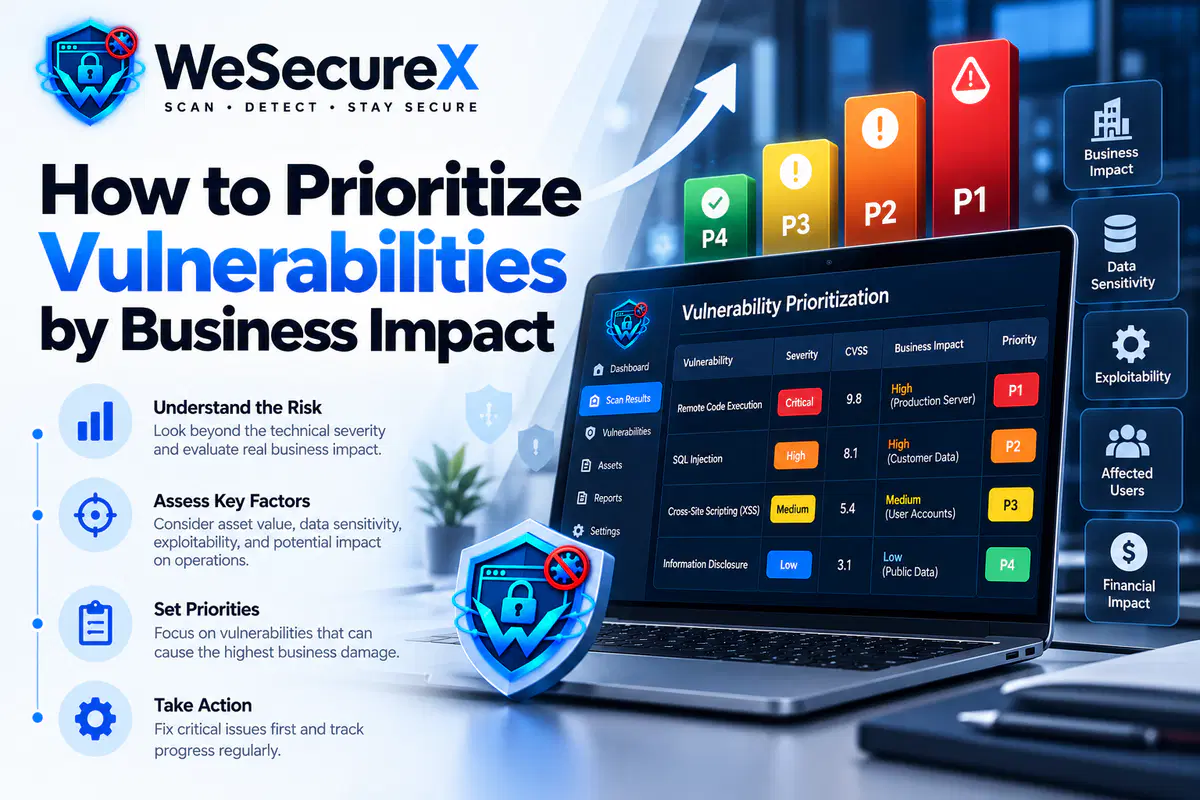
How to Prioritize Vulnerabilities by Business Impact
Your vulnerability scan just finished and returned 214 findings. Forty of them are rated high or critical. Your team has limited hours this week. So which ones do you fix first?
Most teams answer that question with the CVSS score alone. That is a mistake. A critical score on a system nobody can reach matters less than a medium score on the page that processes payments. Real prioritization combines severity with business impact.
This guide gives you a practical framework for prioritization. If you are new to scanning, start with our vulnerability scanning guide. If you need a refresher on scoring, read our post on CVE vs CWE vs CVSS.
Quick Answer
To prioritize vulnerabilities by business impact, score each finding on four things: severity, exploitability, asset value, and exposure. Multiply those factors together. Fix anything that is both easily exploitable and touching sensitive data or revenue first. Everything else goes into a scheduled queue.
Why Severity Alone Fails
The CVSS base score measures the technical severity of a flaw. It does not know your business. It does not know that one server hosts your checkout flow and another hosts a staging copy of an old brochure site.
Treating every 9.8 as equally urgent creates two problems. First, your team burns out chasing findings that carry little real risk. Second, genuinely dangerous issues get buried in a long list of noise.
Severity tells you how bad the flaw could be. Business impact tells you how much it matters to you.
The 6 Factors That Drive Real Priority
Use these six factors to rank every finding.
1. Technical Severity
Start with the CVSS base score. It is a useful floor, not a final answer. Anything 9.0 or above deserves a fast look. Anything below 4.0 rarely deserves emergency attention.
2. Exploitability in the Wild
A high score with no known exploit is less urgent than a medium score being actively used by attackers. Check the CISA Known Exploited Vulnerabilities Catalog and the NIST National Vulnerability Database for exploit signals. If a flaw is on the known exploited list, treat it as critical regardless of score.
3. Asset Value
What does this system do for the business? A payment gateway, customer portal, and admin console are high value. A demo environment is low value. Write down your top ten business critical assets and keep that list current.
4. Internet Exposure
Is the asset reachable from the public internet? An authentication bypass on a public login page is far more dangerous than the same flaw on an internal tool behind a VPN. Exposure changes the attacker's cost.
5. Data Sensitivity
Does the system store or process personal data, payment details, health records, or credentials? If yes, raise the priority. Standards like PCI DSS and GDPR for developers also create legal obligations that raise impact.
6. Blast Radius
If this system is compromised, what else falls? A single service account with wide permissions can become a path to everything. Look for chained risk, not just isolated findings.
A Simple Scoring Model You Can Use Today
You do not need a complex tool to start. Use a 1 to 5 scale on each factor, then multiply.
| Factor | 1 (Low) | 3 (Medium) | 5 (High) |
|---|---|---|---|
| Severity | CVSS under 4 | CVSS 4 to 6.9 | CVSS 7 or higher |
| Exploitability | No known exploit | PoC exists | Actively exploited |
| Asset value | Internal tool | Business system | Revenue or customer facing |
| Exposure | Not reachable | Limited access | Public internet |
| Data sensitivity | Public data | Internal data | Personal or payment data |
| Blast radius | Isolated | Shared service | Broad access |
Multiply the six numbers. A score above 3000 goes to the top of the queue. Anything below 200 goes to the backlog.
This is deliberately rough. The point is to force a conversation, not to produce a perfect number.
A Step by Step Prioritization Process
Step 1: Normalize Your Findings
Deduplicate results. If three tools report the same flaw, it is one fix, not three. Map each finding to a CVE where one exists, and to a CWE category for root cause tracking.
Step 2: Tag Each Finding With Asset Context
Pull in your asset inventory. Mark each system as public or internal, and note whether it holds sensitive data. If you do not have an inventory, build one now. It is the single most valuable input to prioritization.
Step 3: Apply the Scoring Model
Score each finding using the six factors. Keep it fast. Ten seconds per finding is enough. Speed matters more than precision at this stage.
Step 4: Sort Into Four Buckets
Fix now: critical severity, active exploitation, or touching sensitive data on a public asset.
Fix this sprint: high severity with moderate exposure, or medium severity on a critical asset.
Fix this quarter: low exposure, low data sensitivity, or requires significant refactoring.
Accept or monitor: documented risk acceptance with a review date.
Step 5: Assign Owners and Deadlines
A priority without an owner is a wish. Give each finding a name and a date. Track whether the date was met.
Step 6: Re-scan and Verify
After a fix, re-scan to confirm. Our guide on how often should you run a vulnerability scan covers the right cadence. Verification closes the loop.
Using EPSS to Improve Exploit Prediction
The Exploit Prediction Scoring System, or EPSS, estimates the probability that a vulnerability will be exploited in the next 30 days. It is a useful companion to CVSS. A flaw with a CVSS of 9.0 and an EPSS of 0.01 is less urgent than one with a CVSS of 7.5 and an EPSS of 0.6.
Use EPSS as a tiebreaker when two findings have similar business impact.
Common Prioritization Mistakes
Chasing every critical score. Not all criticals are equal. Context decides.
Ignoring internal systems. Attackers often land on a low value box first and pivot inward.
Fixing symptoms instead of patterns. If you keep finding SQL injection and XSS, the issue is a coding practice. Fix the practice too.
Letting the backlog grow forever. Review accepted risks every quarter. Some become urgent as exposure changes.
No documentation. Auditors and customers will ask how you decide. Keep a record.
Skipping the business side. Your CTO sees CVSS. Your CFO sees revenue risk. Speak both languages.
How This Fits Your Security Program
Prioritization is the bridge between scanning and fixing. Scanning without prioritization produces noise. Prioritization without scanning produces guesswork. Together they form the core of risk based vulnerability management.
For a broader view of the moving parts, read our web security basics guide. If your product has APIs, also review API security best practices. Many of the highest impact findings live there.
Quick Checklist
- □
Asset inventory is current
- □
Business critical systems are tagged
- □
Every finding has a CVE or CWE reference
- □
Six factor score applied
- □
Findings sorted into four buckets
- □
Owner and deadline assigned
- □
Known exploited vulnerabilities escalated immediately
- □
Fixes verified with a re-scan
- □
Accepted risks documented with a review date
- □
Quarterly review of the whole backlog
FAQ
Should I always fix CVSS 10 findings first?
No. A 10 on an unreachable test server may rank below a 7.5 on your payment page.
What if I cannot fix everything?
You never can. Document the risk, set a review date, and focus on the highest impact items.
How many findings should we fix per sprint?
It depends on team size. Track a trend, not a single number. The goal is fewer critical findings over time.
Is CVSS still useful?
Yes. It is the starting point. It is just not the whole decision.
Do small teams need this process?
Yes, and they benefit most. Small teams have the least time to waste on low impact work.
Where do I start if I have no inventory?
List your public domains and customer facing apps first. That covers most real risk.
How does compliance fit in?
Frameworks expect documented risk decisions. A prioritization model helps you show that work.
Conclusion
Prioritizing vulnerabilities by business impact is not about ignoring severity. It is about adding context so your team fixes what actually matters. Score severity, exploitability, asset value, exposure, data sensitivity, and blast radius. Sort the results into clear buckets. Assign owners. Verify the fixes.
Do that consistently and your security posture improves every month, even with a small team.
Need help building a prioritization workflow? Explore our guides, browse the WeSecureX blog, check our pricing, or contact us for a security review.
Audit Your Website for Vulnerabilities in Real Time
Run an automated OWASP Top 10 security assessment, check SSL/TLS posture, and map your attack surface.
Related Technical Articles & Research
How to Scan a Website Without Breaking It
Essential DAST best practices: rate limiting, safe request windows, and non-destructive payload testing on production web apps.
What to Do After a Vulnerability Scan: 10 Step Remediation Roadmap
A structured 10-step triage and engineering workflow to verify, prioritize, patch, and re-test reported vulnerabilities.
False Positives in Vulnerability Scanning: How to Triage Them
Techniques to distinguish real security vulnerabilities from scanner noise, verify proof-of-concepts, and streamline security operations.
CVE vs CWE vs CVSS: Plain English Guide for 2026
Demystifying CVE flaw IDs, CWE taxonomy weaknesses, and CVSS v3.1/v4.0 severity scoring metrics for web developers.