Vulnerability Scanning vs Penetration Testing: What’s the Difference?
 WeSecureXOctober 6, 2026
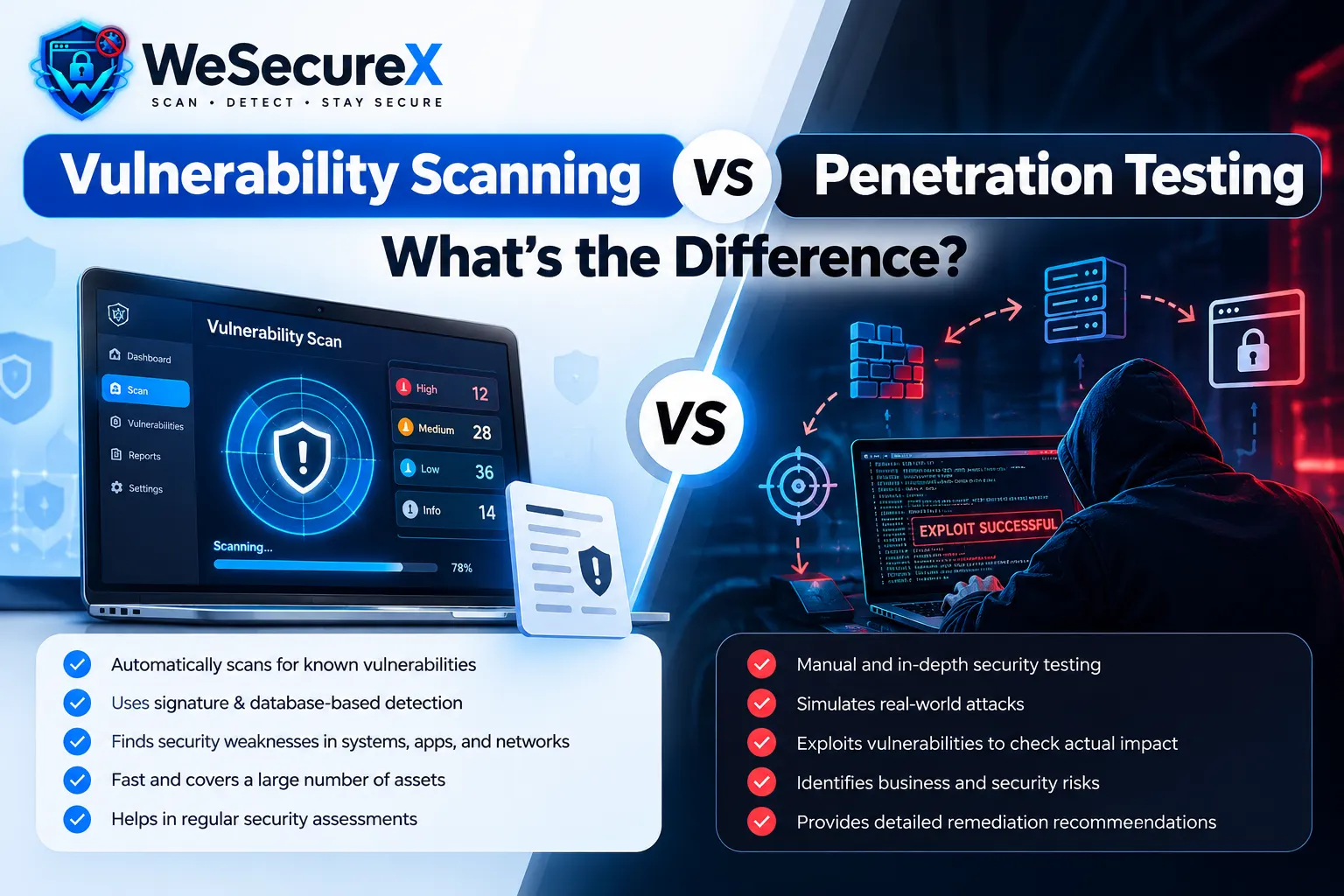
If you run a website, SaaS product, or online store, you’ve probably heard both terms: vulnerability scanning and penetration testing. They sound similar, but they are not the same. One is automated and continuous. The other is manual, deep, and scheduled. Using the wrong one at the wrong time can waste budget or leave critical gaps.
This guide explains the difference, when to use each, which one to do first, and how to combine them into a practical security workflow. If you’re new to security testing, start with our vulnerability scanning guide.
Quick Answer
Vulnerability scanning is automated, broad, and frequent. It finds possible weaknesses.
Penetration testing is manual, deep, and periodic. It proves whether those weaknesses can actually be exploited.
You usually need both — but you should start with scanning.
What Is Vulnerability Scanning?
Vulnerability scanning uses automated tools to check your website, network, or application for known weaknesses. It looks for things like:
Missing patches
Misconfigured servers
Weak TLS/SSL settings
Outdated dependencies
Common web flaws from the OWASP Top 10
Exposed ports and services
Known CVEs listed in the CVE database
Scanners are fast and repeatable. They are ideal for continuous monitoring. For a deeper definition, see What is vulnerability scanning?
They can also flag common attack patterns like SQL injection, XSS, and CSRF.
Best for: weekly scans, post-deployment checks, compliance baselines, and continuous security monitoring.
What Is Penetration Testing?
Penetration testing — often called pentesting — is manual ethical hacking. A tester simulates a real attacker to find and exploit weaknesses. They don’t just run a tool. They think like an attacker.
Pentesting can uncover:
Business logic flaws
Chained vulnerabilities
Authentication bypasses
Privilege escalation
API weaknesses
Session flaws
Real-world attack paths
Most professional pentests follow a methodology such as PTES or the OWASP Web Security Testing Guide.
Best for: pre-launch testing, annual security audits, compliance requirements, and validating critical systems.
Key Differences
| Factor | Vulnerability Scanning | Penetration Testing |
|---|---|---|
| Method | Automated tools | Manual + tools |
| Scope | Broad | Deep |
| Frequency | Daily / weekly / monthly | Quarterly / annually |
| Speed | Fast | Slow |
| Cost | Lower | Higher |
| Output | List of possible issues | Proof of exploitability |
| Skill level | Tool operation + triage | Expert attacker mindset |
| Best use | Continuous monitoring | High-value validation |
When to Use Vulnerability Scanning
Use scanning when you need:
Regular security checks
Fast feedback after deployments
Compliance evidence for standards like PCI DSS
A baseline before a pentest
Continuous monitoring of known CVEs
Scanning is not a one-time event. It should be part of your web security basics workflow.
When to Use Penetration Testing
Use pentesting when you need:
A major launch or redesign validated
Annual compliance testing
A deep review of APIs and authentication
Proof that critical flaws are fixed
Attacker-style testing of business logic
For API-heavy products, pair pentesting with our API security best practices.
Which One Should You Do First?
Start with vulnerability scanning.
Here’s why:
It gives you a fast baseline.
It finds low-hanging fruit you can fix immediately.
It reduces noise before an expensive pentest.
It helps you prioritize what a pentester should focus on.
Then, once critical issues are fixed, bring in a pentester to go deeper.
How Often Should You Test?
A practical schedule:
Vulnerability scanning: weekly, or after every major deployment
Penetration testing: annually, after major changes, or before a major launch
Compliance-driven testing: as required by your standard
If you handle payments, review PCI DSS basics. If you handle personal data, review our compliance and security guides.
How They Work Together
The strongest security programs combine both:
Run automated scans continuously.
Triage findings using CVSS.
Fix critical issues.
Re-scan to confirm.
Schedule a pentest for deeper validation.
Repeat.
This is how you move from reactive firefighting to proactive security.
Quick Checklist
- □
Run a baseline vulnerability scan
- □
Review findings against the OWASP Top 10
- □
Fix critical and high-risk issues
- □
Re-scan to confirm fixes
- □
Schedule a penetration test
- □
Document results for compliance
- □
Set up continuous monitoring
FAQ
Is vulnerability scanning enough?
No. It finds possible issues, but it cannot prove exploitability like a pentest can.
Can a scanner replace a pentester?
No. Scanners are fast and broad, but they miss logic flaws and chained attacks.
How often should I pentest?
At least annually, or after major changes. Some compliance standards require more.
Do I need both for GDPR or PCI DSS?
It depends on your scope, but both are commonly expected for strong compliance.
What should I fix first?
Start with critical and high-risk findings, especially those exposed to the internet.
Conclusion
Vulnerability scanning and penetration testing are not competitors. They are teammates. Scanning gives you speed, coverage, and continuous visibility. Pentesting gives you depth, proof, and attacker insight. Start with scanning, fix what you can, then validate with a pentest.
Need help? Explore our pricing or contact us. You can also read more on our blog.
Audit Your Website for Vulnerabilities in Real Time
Run an automated OWASP Top 10 security assessment, check SSL/TLS posture, and map your attack surface.
Related Technical Articles & Research
How to Scan a Website Without Breaking It
Essential DAST best practices: rate limiting, safe request windows, and non-destructive payload testing on production web apps.
What to Do After a Vulnerability Scan: 10 Step Remediation Roadmap
A structured 10-step triage and engineering workflow to verify, prioritize, patch, and re-test reported vulnerabilities.
False Positives in Vulnerability Scanning: How to Triage Them
Techniques to distinguish real security vulnerabilities from scanner noise, verify proof-of-concepts, and streamline security operations.
How to Prioritize Vulnerabilities by Business Impact
Contextual risk scoring: why raw CVSS scores fall short and how asset criticality and exploitability dictate remediation urgency.