CVE vs CWE vs CVSS: Plain English Guide for 2026
 WeSecureXOctober 9, 2026
CVE vs CWE vs CVSS: Plain English Guide for 2026
If you have ever read a vulnerability report, you have seen strings of numbers and acronyms that look like a secret code. CVE, CWE, CVSS. They appear in scanner output, patch notes, vendor advisories, and compliance documents. Most guides explain them in dense technical language that leaves you more confused than when you started.
This guide fixes that. You will learn what each term means, how they differ, how they work together, and how to use them to fix the right risks first. If you are new to security testing, start with our vulnerability scanning guide.
Quick Answer
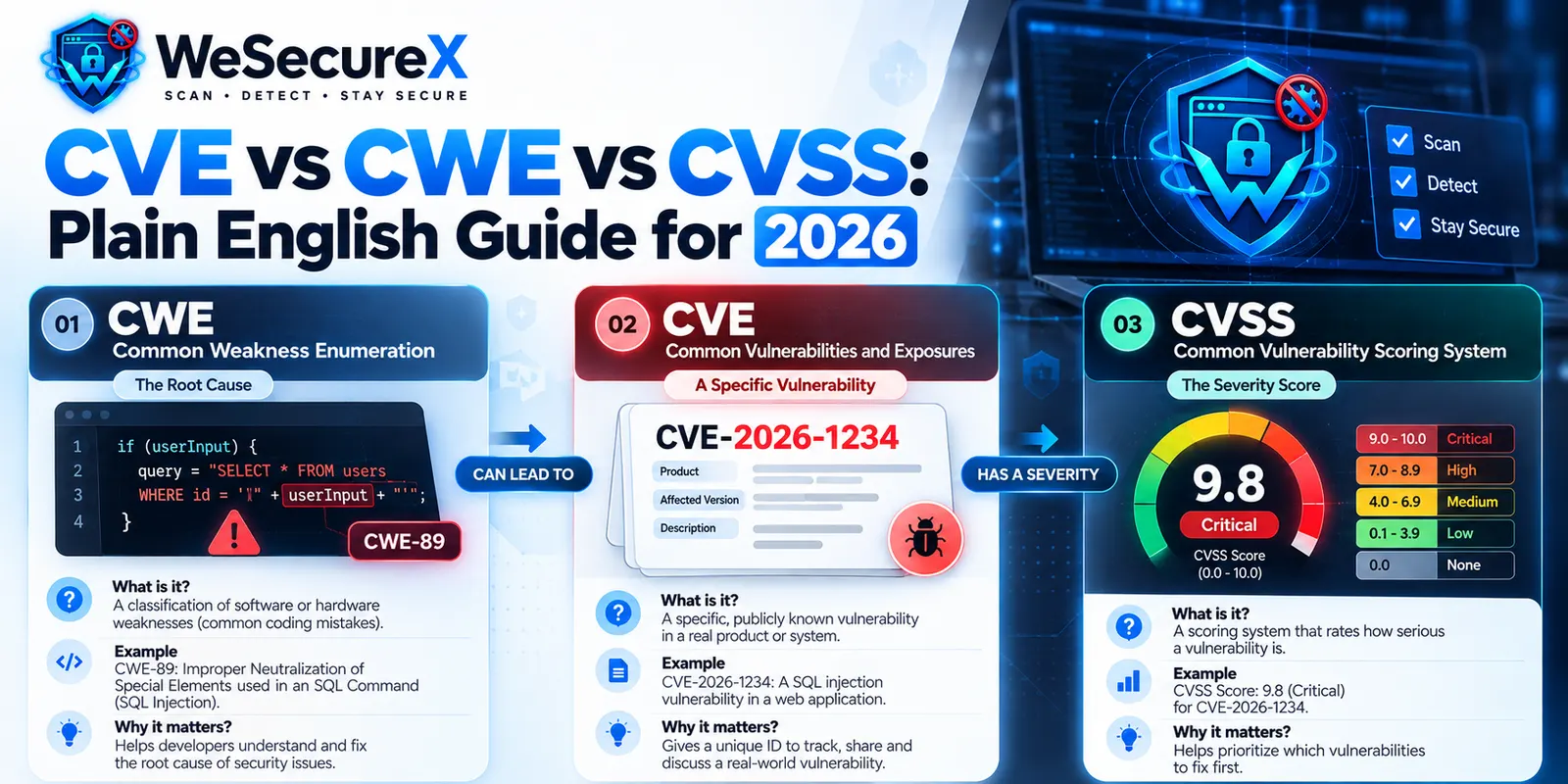
CVE is the ID number of a specific known vulnerability.
CWE is the category or type of weakness behind it.
CVSS is the severity score that tells you how bad it is.
Think of it this way: CWE is the disease, CVE is the diagnosed case, and CVSS is the severity rating on the chart.
Why These Three Terms Matter
Your scanner will report hundreds of findings. You cannot fix everything at once. You need a way to name issues, group them, and rank them. That is exactly what these three systems do:
CVE gives each vulnerability a unique name so everyone refers to the same thing.
CWE groups vulnerabilities by root cause so you can fix patterns, not just symptoms.
CVSS ranks severity so you know what to fix first.
Without them, every security conversation becomes guesswork. With them, you can prioritize with confidence.
What Is CVE?
CVE stands for Common Vulnerabilities and Exposures. It is a public catalog of known security flaws. Each entry gets a unique identifier that looks like this:
CVE-2021-44228
That identifier is permanent. It does not change. It is used worldwide by vendors, scanners, researchers, and security teams. The program is managed by the CVE Program, and enriched details are published in the NIST National Vulnerability Database.
What a CVE Entry Contains
A typical CVE record includes:
A unique ID
A short description of the flaw
The affected product or version
References to advisories and patches
The date it was published
What CVE Does Not Tell You
A CVE does not tell you how severe the issue is. It does not tell you if it is being exploited. It does not tell you whether your system is affected. It simply says: this vulnerability exists and here is its name.
That is why you need CVSS and CWE alongside it.
Famous CVE Examples
CVE-2021-44228 (Log4Shell): a critical flaw in the Log4j logging library that affected millions of systems.
CVE-2017-0144 (EternalBlue): the flaw used by the WannaCry ransomware attack.
CVE-2014-0160 (Heartbleed): a bug in OpenSSL that exposed sensitive memory contents.
Each of these started as a CVE ID before becoming a global incident.
What Is CWE?
CWE stands for Common Weakness Enumeration. It is a catalog of weakness types, not individual bugs. The CWE list is maintained by MITRE and describes categories of coding and design errors.
A CWE entry looks like this:
CWE-79: Improper Neutralization of Input During Web Page Generation
That is the official name for cross site scripting. If you want a practical explanation, read our guide on XSS cross site scripting.
Why CWE Matters More Than You Think
Fixing one CVE fixes one instance. Fixing a CWE fixes a class of bugs forever. That is the real value.
If your scanner keeps finding injection flaws, the problem is not the individual findings. The problem is a missing secure coding practice. CWE tells you where to aim your training, your code review checklist, and your developer education.
Common CWE Examples
CWE-79: Cross site scriptingCWE-89: SQL injectionCWE-352: Cross site request forgeryCWE-287: Improper authenticationCWE-798: Use of hard coded credentials
Many of these map directly to the OWASP Top 10, which is the most widely used list of web application risks.
What Is CVSS?
CVSS stands for Common Vulnerability Scoring System. It is a framework for rating the severity of a vulnerability on a scale from 0.0 to 10.0. The standard is maintained by FIRST.
CVSS answers one question: how bad is this if it is exploited?
CVSS Severity Ranges
| Score Range | Severity |
|---|---|
| 0.0 | None |
| 0.1 to 3.9 | Low |
| 4.0 to 6.9 | Medium |
| 7.0 to 8.9 | High |
| 9.0 to 10.0 | Critical |
Anything scoring 9.0 or above usually triggers an emergency response. Anything below 4.0 often gets scheduled, not rushed.
The Three CVSS Metric Groups
CVSS is built on three groups of metrics:
Base metrics describe the intrinsic qualities of the vulnerability. These include attack vector, attack complexity, privileges required, user interaction, scope, and impact on confidentiality, integrity, and availability. The base score never changes once published.
Temporal metrics describe characteristics that change over time, such as whether a working exploit exists or whether a patch is available.
Environmental metrics describe your specific environment, such as whether the affected system is internet facing or handles sensitive data.
Most scanner reports show the base score. That is a starting point, not the final answer.
A Real CVSS Example
Take a remotely exploitable flaw that requires no authentication, no user interaction, and allows full system takeover. It would likely score 9.8 or 10.0, which is critical.
Now take a flaw that requires local access, a valid account, and unusual conditions. It might score 4.5, which is medium.
Same type of bug, very different urgency.
CVE vs CWE vs CVSS: Side by Side
| Factor | CVE | CWE | CVSS |
|---|---|---|---|
| Full name | Common Vulnerabilities and Exposures | Common Weakness Enumeration | Common Vulnerability Scoring System |
| What it is | A unique ID for a specific flaw | A category of weakness type | A severity score |
| Format | CVE-2021-44228 | CWE-79 | 9.8 (Critical) |
| Scope | One instance | One class of bugs | One vulnerability rating |
| Changes over time | No, the ID is fixed | No, categories are stable | Base score is fixed, temporal and environmental scores change |
| Main use | Naming and tracking | Root cause analysis and prevention | Prioritization and triage |
| Who uses it | Vendors, scanners, researchers | Developers and security teams | Security teams and management |
How They Work Together
Here is a simple workflow that shows how all three fit:
Your scanner finds a flaw and reports it as
CVE-2024-12345.The CVE record links to a CWE category, for example
CWE-89for SQL injection.The CVSS base score is 9.8, which means critical.
You check the CISA Known Exploited Vulnerabilities Catalog and see it is actively exploited.
You fix it immediately.
You then review your code for other instances of
CWE-89and fix the pattern.
That last step is what separates teams that keep getting breached from teams that get safer over time.
A Practical Example: Log4Shell
Let us walk through Log4Shell using all three systems.
CVE:
CVE-2021-44228is the specific identifier for the Log4j flaw.CWE: It maps to
CWE-917, which covers expression language injection.CVSS: The base score was 10.0, the maximum possible.
The CVE told the world what to patch. The CWE told developers what class of mistake caused it. The CVSS told executives why it needed immediate attention. All three were needed for a full response.
Why This Matters for Your Business
Understanding these three systems changes how you talk about risk:
With engineering, you talk about CWE so you can fix root causes.
With operations, you talk about CVE so you can track specific patches.
With leadership, you talk about CVSS so you can justify budget and urgency.
If you are working toward a compliance standard, this vocabulary also matters. Auditors for PCI DSS and similar frameworks expect you to track vulnerabilities in a structured way.
Common Mistakes to Avoid
Treating CVSS as the only factor. A 9.8 on an isolated internal test box may matter less than a 7.5 on your public login page. Always add environmental context.
Ignoring CWE. If you only fix CVEs, you will keep finding the same bugs in new places.
Chasing every low finding. A CVSS score of 3.0 rarely deserves emergency attention. Fix the critical and high items first, then work down.
Forgetting exploitability. A high score with no known exploit is less urgent than a medium score being actively exploited in the wild.
Not re-scanning after fixes. Always confirm that the fix worked. Our post on how often should you run a vulnerability scan covers the right cadence.
Quick Reference Checklist
- □
Every finding has a CVE ID where one exists
- □
Each CVE is mapped to a CWE category
- □
CVSS base scores are recorded
- □
Environmental context is applied before prioritization
- □
Actively exploited issues are escalated immediately
- □
Recurring CWE patterns trigger developer training
- □
Fixes are confirmed with a re-scan
- □
Records are kept for compliance
FAQ
What is the difference between CVE and CWE in one sentence?
CVE names a specific vulnerability, while CWE names the type of weakness that caused it.
Is CVSS the same as a CVE score?
No. CVSS is the scoring system. A CVE is the identifier. A CVE record usually includes a CVSS score.
Can a CVE have multiple CWE mappings?
Yes. A single vulnerability can stem from more than one weakness type.
Is a CVSS score of 10 always the most urgent?
Not always. A 10.0 on an unreachable system may be less urgent than a 7.5 on your payment page. Context matters.
Who assigns CVE IDs?
CVE IDs are assigned by CVE Numbering Authorities, which include vendors, research organizations, and MITRE.
Do I need to know all three to run a scan?
No, but you need them to prioritize and fix effectively. Scanning without prioritization creates noise.
Where can I read more?
Start with our vulnerability scanning guides and browse the WeSecureX blog for related topics.
Conclusion
CVE, CWE, and CVSS are not competing standards. They are three parts of one system. CVE gives vulnerabilities a name. CWE gives them a category. CVSS gives them a severity. Use all three together and you stop guessing about what to fix first.
If you want help turning raw scanner output into a prioritized action plan, explore our pricing or contact us for a security review.
Audit Your Website for Vulnerabilities in Real Time
Run an automated OWASP Top 10 security assessment, check SSL/TLS posture, and map your attack surface.
Related Technical Articles & Research
How to Scan a Website Without Breaking It
Essential DAST best practices: rate limiting, safe request windows, and non-destructive payload testing on production web apps.
What to Do After a Vulnerability Scan: 10 Step Remediation Roadmap
A structured 10-step triage and engineering workflow to verify, prioritize, patch, and re-test reported vulnerabilities.
False Positives in Vulnerability Scanning: How to Triage Them
Techniques to distinguish real security vulnerabilities from scanner noise, verify proof-of-concepts, and streamline security operations.
How to Prioritize Vulnerabilities by Business Impact
Contextual risk scoring: why raw CVSS scores fall short and how asset criticality and exploitability dictate remediation urgency.