1. Malicious Open-Source Packages & Typosquatting
Attackers systematically exploit open-source package resolution mechanics:
Open-Source Package Attack Mechanics & Defenses
| Attack Vector | Exploitation Method | Engineering Defense Pattern |
|---|---|---|
| Typosquatting | Registering lookalike package names (expresss vs express) | Strict package lockfiles & automated dependency linters |
| Maintainer Account Takeover | Stealing npm credentials via credential stuffing | Enforcing mandatory 2FA/WebAuthn for package maintainers |
| Dependency Confusion | Publishing higher-version public packages shadowing private internal packages | Scoping internal packages (@company/*) to private registries |
| Lifecycle Script Malware | Executing arbitrary shell commands inside postinstall hooks | Running CI dependency installs with --ignore-scripts |
Audit your application dependencies continuously for open vulnerability disclosures inside the [WeSecureX Vulnerabilities Catalog](/vulnerabilities).
2. Poisoned GitHub Workflows & Action Hardening
GitHub Actions workflows present a massive attack surface when improperly configured. Using mutable action tags (like uses: actions/checkout@v4) allows an attacker who compromises the upstream Action repository to inject malicious code into your build execution environment.
Furthermore, misusing the pull_request_target trigger allows untrusted pull requests from external forks to execute code with access to repository secrets.
# Production Hardened GitHub Actions Workflow
name: Secure Build & Test

on:
  pull_request:
    branches: [main]

# Enforce strict least-privilege token permissions by default
permissions:
  contents: read

jobs:
  build:
    runs-on: ubuntu-latest
    steps:
      # Pin Actions strictly to 40-character commit SHAs
      - name: Checkout Code
        uses: actions/checkout@b4ffde65f46336ab88eb53be808477a3936bae11 # v4.1.1

      - name: Setup Node
        uses: actions/setup-node@60ed15dd54556351787847d9e6001717534b79d3 # v4.0.2
        with:
          node-version: 20

      # Disable lifecycle scripts during dependency installation
      - name: Install Dependencies
        run: npm ci --ignore-scripts
Business Controls & SBOM Manifest Generation
Supply chain security requires continuous organizational governance. Require mandatory code owners on all workflow file modifications (.github/workflows/*), enforce short-lived OIDC tokens for cloud deployments, and produce standardized Software Bill of Materials (SBOM) manifests in CycloneDX format for all production container releases.
Review team integrations and permissions inside the WeSecureX Settings Panel.
Never pass repository secrets to untrusted third-party GitHub Actions. Always review the source code of external Actions before adding them to core deployment pipelines.
SLSA Framework & Cryptographic Build Provenance
To defend against attacks targeting the build pipeline itself (such as compromised CI runners injecting malware into release binaries), enterprise engineering teams adopt the Supply chain Levels for Software Artifacts (SLSA) framework.
Cryptographic Attestation & Sigstore Cosign
SLSA Level 3 requires that software artifacts be built on isolated, hosted build platforms with non-falsifiable provenance.
- Immutable Build Provenance: Automated CI workflows generate signed in-toto provenance attestations documenting the exact source repository commit, build parameters, and dependency hashes used to construct the artifact.
- Keyless Signing via Sigstore: Use Sigstore Cosign to sign container images and npm release tarballs using OpenID Connect (OIDC) identities, eliminating static private keys that can leak.
- Admission Control Verification: Kubernetes clusters and serverless runtimes enforce admission controllers (such as Kyverno or OPA Gatekeeper) to reject any container image lacking a valid cryptographic signature from your approved CI pipeline.
# Example Sigstore Cosign Image Signing & Attestation
$ cosign sign --yes \
    --oidc-provider=github \
    ghcr.io/company/web-api:v2.4.1

[INFO] Generating ephemeral keypair via Sigstore Fulcio
[INFO] Signing artifact with GitHub Actions OIDC identity
[INFO] Logging signature to Rekor immutable transparency log
[CONFIRM] Image successfully signed with cryptographic provenance!
5. Automating Software Composition Analysis (SCA) & CVE Triage with WeSecureX
Manual review of dependency release logs cannot scale across modern enterprise repositories that import thousands of direct and transitive open-source packages.
Automated Dependency Vulnerability Gating
The WeSecureX Platform provides continuous dependency and perimeter monitoring:
- Continuous CVE Telemetry: WeSecureX correlates your package manifests against the National Vulnerability Database (NVD) and GitHub Advisory Database in real time.
- Transitive Dependency Mapping: Flags vulnerabilities buried deep in nested dependency trees that do not appear in top-level
package.jsonmanifests. - Pull Request Quality Gates: Integrates directly into GitHub Actions or GitLab CI, automatically failing pull requests that introduce new packages with known High or Critical CVEs (CVSS >= 7.0).
- Automated Fix PRs: Generates pull requests to bump vulnerable packages to patched semver releases without breaking API compatibility.
Monitor your repository and third-party script vulnerabilities continuously in the [WeSecureX Vulnerabilities Catalog](/vulnerabilities).
# WeSecureX Automated SCA Pull Request Gate
$ wesecurex sca audit --manifest package-lock.json --fail-on-cvss 7.0

[SCA] Scanned 1,482 dependencies (direct & transitive)
[ALERT] CVE-2026-2184 (CVSS 8.6 HIGH) detected in express-fileupload@1.4.0
[VULN] Unsanitized parameter name leads to prototype pollution & RCE
[PATCH] Upgrade available: express-fileupload@1.5.0
[EXIT] Build gated: Merges blocked until dependency is upgraded.
Apply it with WeSecureX
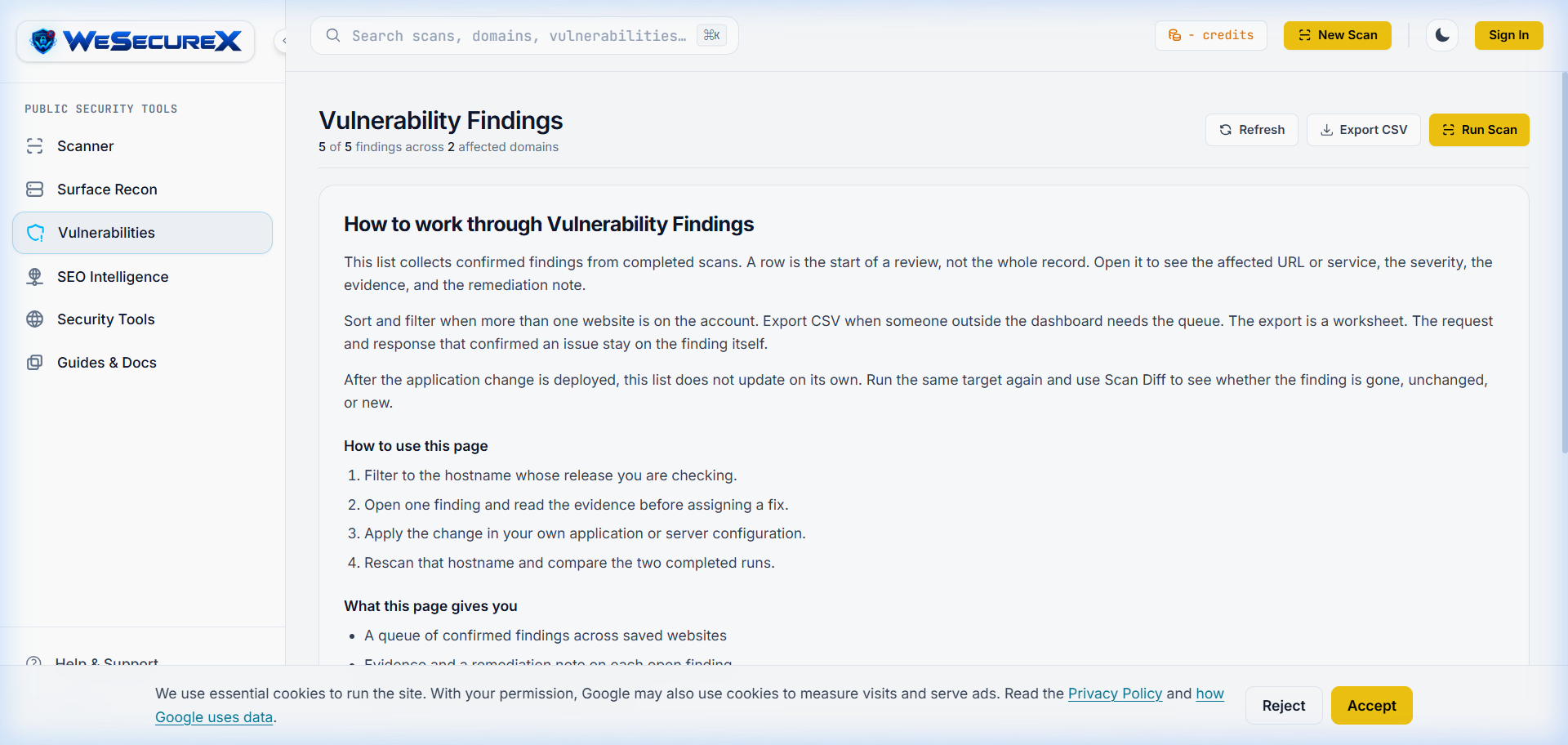
WeSecureX checks the dependencies and response headers of a site you own for known-vulnerable package versions and leaked build metadata. A finding is kept when a shipped asset matches a flagged version.
Fingerprint on a shipped bundle
GET /assets/vendor.js HTTP/1.1
Host: yoursite.com
Version banner that matches an advisory
/*! library v1.2.3 */ # 1.2.3 has a published advisoryThe finding names the package, the version served to visitors, and the advisory it maps to, so you can confirm the vulnerable code is actually live.
Fix: pin and upgrade
npm ci --ignore-scripts   # deterministic install
npm install library@^1.2.4 # patched
After the rescan
Rescan the same host. When the patched version is the one served, the version no longer matches the advisory and the finding clears.
WeSecureX modules for this topic
Checks that belong with this topic
- Pin all third-party GitHub Actions to 40-character commit SHAs.
- Set permissions: contents: read by default across workflow files.
- Execute npm ci --ignore-scripts in automated build environments.
- Scope all private enterprise packages using explicit @organization namespaces.
- Authenticate CI pipelines to cloud platforms using OIDC federated tokens.
- Track open dependency vulnerabilities in the [[WeSecureX Vulnerabilities Catalog](/vulnerabilities)](/vulnerabilities).
Actionable Checklist
WeSecureX Platform · Scanner Engine
Automated Vulnerability Scanner
Launch targeted or full-domain security audits to detect OWASP Top 10 vulnerabilities automatically.
Includes: OWASP Top 10 automated test suites · Real-time severity scoring (CVSS v3.1) · Instant remediation code snippets
Frequently Asked Questions
Git tags are mutable references that can be updated or re-pointed by repository maintainers (or attackers who compromise maintainer accounts). A commit SHA is a cryptographically immutable digest that can never be modified.
`pull_request` runs untrusted fork code in a sandboxed environment without access to repository secrets. `pull_request_target` runs in the context of the base repository with access to secrets; misusing it allows external attackers to steal deployment tokens.
Dependency Confusion occurs when a package manager installs a malicious higher-version package from a public registry (like npmjs.com) instead of your internal private package with the same name.
It prevents malicious packages from executing shell scripts defined in `preinstall` or `postinstall` hooks during `npm ci`, neutralizing script-based credential exfiltration.
Connect your GitHub repositories to the [[WeSecureX Vulnerabilities Catalog](/vulnerabilities)](/vulnerabilities) to receive automated alerts whenever new CVEs affect your dependencies.
Authoritative Sources & References
- GitHub - Security hardening for GitHub ActionsGitHub (official)View Source
Related Guides
Continue exploring related technical architecture and defensive guides
supply chain · SCA
Dependency & Supply Chain Security: SCA, Lockfiles & Malicious Packages
Your app's risk includes every transitive package - pin lockfiles, scan continuously, and harden install/CI against typosquatting and dependency confusion.
secrets · DevOps
Secrets Management for Web Apps: Keys, Env Vars & Rotation
Keep API keys and credentials out of git, browsers, and logs - with rotation and least privilege baked in.
vulnerability scanning · DAST
What Is Vulnerability Scanning? Complete Guide
An authoritative guide to automated vulnerability scanning: how scanners crawl and audit applications, how DAST contrasts with SAST and SCA, and how to triage findings effectively.